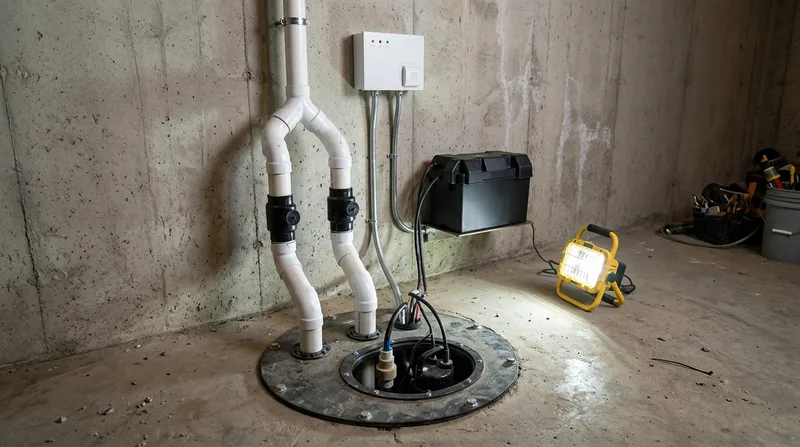




Battery Backup Sump Pumps in Scranton: Keep the Pump Running When the Grid Drops
Scranton sits in the narrow Lackawanna Valley between steep wooded ridges, and that geography drives the water problem. Glacial till over shale, old anthracite mine workings that settle and crack foundations, and river and creek bottoms that flooded in 2006 and again during Tropical Storm Lee in 2011 all push water at below-grade walls. Add heavy nor'easter and lake-effect snow, spring snowmelt, and hard freeze-thaw cycles, and your sump pump is the one machine standing between a wet basement and a dry one. Battery Backup Sump Pumps in Scranton keep that machine running when the power goes out, which is exactly when the storm is at its worst. If your primary pump is already cycling hard, start with our sump pump installation and replacement page, then add the backup.
Why a Backup Pump Matters in Scranton's Old Basements and Storm Seasons
Most of the housing stock here was not built with a backup in mind. Hill Section and Green Ridge Victorians sit on fieldstone and brick foundations, West Side and South Side double-blocks from the 1890s to 1930s sit on stone, and the coal-patch boroughs of Dunmore, Old Forge, and Taylor share the same pattern. A single pump on a tired circuit is a single point of failure.
- Summer thunderstorms knock out power across the valley just as the sump basin fills fastest.
- Spring snowmelt saturates glacial clay soil and keeps hydrostatic pressure on the footing drain for weeks.
- Older homes in the Hill Section often have undersized pits and no check valve, so a backup needs a proper install, not a drop-in.
- Mine subsidence under parts of the valley can shift a basin or crack a floor, changing how fast water arrives.
We size the backup to the pit you actually have, not to a spec sheet, because a pump that cannot keep up is no better than no pump at all.
Key info: A 2011-style flood event in the Lackawanna River bottoms can leave a basement sump running for days. A battery backup rated for 6 to 8 hours of continuous run time is the minimum we recommend for homes in South Side and along the river flats.
For official storm and flood preparedness guidance, the National Weather Service publishes local alerts that give you time to check the pump before the cell arrives.
How We Install a Battery Backup Sump Pump in a Scranton Basement
We treat the backup as part of the whole below-grade system, not a box on the floor. On a 1950s ranch in Clarks Summit with a block basement, the sequence looks different than on a 1900s double-block in Throop with a stone foundation and a shallow pit. Here is the process we follow on every job.
- We inspect the existing sump basin, pump, check valve, and discharge line to confirm the primary system is sound.
- We measure pit diameter and depth, then match a backup pump and float to the basin and the inflow you actually see.
- We mount the backup battery in a ventilated, elevated position clear of floor seepage and test the charger circuit.
- We tie the backup discharge into the existing line with its own check valve so the two pumps do not fight each other.
- We run a full simulated power-loss test and set the alarm so you hear it before the water rises.
If the inspection turns up a failing footing drain or a saturated perimeter, we say so plainly and point you to interior drain tile rather than selling you a bigger battery for a drainage problem.
Key info: On a recent job in Dunmore, the homeowner's primary pump ran fine but the discharge line had no check valve, so every cycle dumped water back into the basin. A backup alone would have masked the problem. We corrected the line and added the backup in the same visit.
Backup Pump Options We Install
Not every basement needs the same hardware. We match the approach to the pit, the inflow, and how long outages tend to last on your street.
| Approach | Description | Best for |
|---|---|---|
| Battery backup pump | A 12V DC pump on a dedicated battery and charger, tied into the existing discharge line. | Most Scranton homes with a working primary pump and short to moderate outages. |
| Combination primary and backup unit | One housing with an AC primary and DC backup, shared float and discharge. | Tight pits in older Hill Section and West Side basements where space is limited. |
| Extended battery bank | Additional batteries to stretch run time through long outages. | River-bottom homes in South Side and along creek flats where outages last days. |
| High-water alarm only | A float alarm that sounds when water rises above the normal shutoff level. | Homeowners who want early warning before adding a full backup. |
We test every configuration under a simulated outage before we leave, because a backup you have never heard run is a backup you cannot trust.
Battery Backup Sump Pumps Cost in Scranton: What to Expect
Most homeowners here are looking at a starting point around $900 for a standard battery backup install, and that figure moves with the pit and the hardware. A clean 1990s poured-concrete basement in the Abingtons with a modern pit is the simple case. A stone-foundation double-block in Taylor with a shallow pit and no check valve takes more labor and parts.
- Pit size and depth drive whether a standard or combination unit fits without modification.
- Battery capacity and run time change the price more than any other single choice.
- Discharge line condition matters, since a missing check valve or undersized line has to be corrected.
- Access to the basement and the electrical circuit adds labor on finished or tight spaces.
We recommend getting two or three estimates and comparing what is actually included, not just the bottom line. Our full breakdown lives on the pricing page.
Battery Backup Sump Pumps Near Me: How to Choose a Contractor Near Scranton
When you search for battery backup sump pumps near me, the results all look similar. The differences show up in the details: whether the crew understands stone foundations, mine subsidence, and freeze-thaw, and whether they will tell you when a backup is not the right first fix.
- Confirm the contractor is licensed and insured, and ask for a certificate before work begins.
- Get multiple written estimates that itemize the pump, battery, check valve, and labor separately.
- Ask for local references, especially homes with the same foundation type as yours.
- Ask whether a permit is required for any electrical or discharge changes, and confirm the local building department's rules, which vary by jurisdiction.
- Check that the contractor is a member of a trade body such as the Basement Health Association, which we are.
We are happy to walk you through the scope before you commit. Reach us through the contact page or call (272) 770-2393.
Battery Backup Sump Pumps in Scranton: Pricing Guide
| Service | Price | Details |
|---|---|---|
| Battery backup pump install | Starting at $900 | Includes pump, battery, charger, check valve, and simulated outage test on a standard pit. |
| Combination primary and backup | Starting at $1,200 | One housing with AC primary and DC backup, sized to tight older pits. |
| Extended battery bank | Starting at $1,450 | Adds batteries for multi-day outages common in river-bottom neighborhoods. |
| High-water alarm add-on | Starting at $250 | Float alarm installed and tested on your existing basin and pump. |
| Complex or large-scale job | On estimate | Stone foundations, shallow pits, or discharge line corrections need an on-site look first. |
| Estimate | Free | Response within 24h at (272) 770-2393, no obligation to book. |
Indicative pricing, the exact cost depends on square footage, finish, and site access. Free personalized estimate within 24h at (272) 770-2393.


