



Foundation Crack Repair in Scranton: What Every Homeowner in the Lackawanna Valley Needs to Know
Scranton sits in a narrow valley where glacial till and shale sit above old anthracite mine workings, and that geology puts constant stress on residential foundations. The city's 1870s to 1920s Victorians and Queen Anne homes in the Hill Section and Green Ridge were built on fieldstone and brick, while the frame double-blocks of the West Side and South Side sit on stone foundations that have been absorbing freeze-thaw cycles for a century. When you need Foundation Crack Repair in Scranton, the crack you see is rarely the whole story. Water finds the path of least resistance, and in this valley that path often runs straight through a hairline fracture in a poured wall or a mortar joint in a stone foundation. We inspect before we inject, because a crack that is still moving needs a structural assessment, not a tube of epoxy. If you are already seeing water on the floor, start with our basement waterproofing service to understand the bigger picture.
Why Foundation Cracks Are a Scranton Problem, Not a Cosmetic One
The dominant failure mode in Scranton is hydrostatic pressure driven by spring snowmelt and heavy nor'easter rain. The ground here is glacial clay soil that holds water like a sponge, and the water table rises fast after a storm. Old mine workings beneath much of the valley can settle and shift, which turns a simple shrinkage crack into a moving joint. Add the hard freeze-thaw cycles that hit the Lackawanna Valley every winter, and you get foundations that flex, crack, and weep.
- Fieldstone and brick foundations in the Hill Section and Green Ridge develop mortar joint cracks that let water pour in during a thaw.
- Poured-concrete basements in Clarks Summit and South Abington crack at the cold joints and around tie holes when hydrostatic pressure builds.
- Block foundations in the 1950s to 1970s ranches of Dunmore and Taylor show stair-step cracking at the corners after a wet spring.
- Homes near the river and creek bottoms that flooded in 2006 and during Tropical Storm Lee in 2011 often have silt-clogged drain tile that backs water up to the wall.
If you see white powder on the wall, that is efflorescence, and it means water is moving through the concrete right now. A crack that is actively leaking will not seal itself, and ignoring it lets the freeze-thaw cycle widen it year after year.
Key info: A homeowner in Old Forge called us after a February thaw sent water across the basement floor. The crack was a vertical shrinkage crack in a poured wall, but the real culprit was a downspout that dumped roof water right at the corner. We injected the crack and extended the downspout, and the wall has stayed dry since.
Before you authorize any repair, check the permit requirements with the City of Scranton building department, since structural foundation work and drainage alterations can trigger a permit review.
How We Diagnose and Repair Foundation Cracks in Scranton
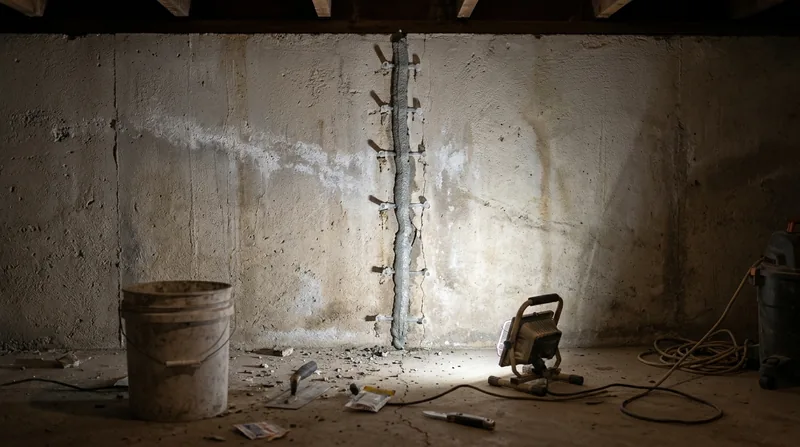
We do not patch cracks one-size-fits-all. Every job starts with a walkthrough of the basement and the exterior grade, and we look at the crack width, the direction, and whether the wall is bowing. If the wall is moving, we stop and recommend a structural assessment before any injection. If the crack is stable and leaking, we inject it. The method follows the diagnosis, not the other way around.
- We inspect the crack and the surrounding wall, and we check for efflorescence, moisture, and any sign of movement.
- We drill injection ports along the crack at the proper spacing for the crack width and the wall material.
- We flush the crack with water or compressed air to clear loose debris and mortar dust.
- We seal the surface with an epoxy paste so the injection material stays in the crack.
- We inject epoxy for structural cracks or polyurethane for active leaks, matching the material to the condition.
- We remove the ports, finish the surface, and verify the repair under pressure before we leave.
On a stone foundation in the West Side, we often have to repoint mortar joints before injection, because the crack runs through the mortar and not the stone. On a poured wall in Dickson City, the repair is usually a clean epoxy injection that restores the wall's structural continuity.
Key info: A split-level in South Abington had a horizontal crack running the length of the front wall. That is a sign of soil pressure, not shrinkage. We referred the homeowner to our bowing wall repair service and did not inject the crack, because injection alone would have hidden a structural problem.
Injection Methods We Use in Scranton
| Approach | Description | Best for |
|---|---|---|
| Epoxy injection | A two-part structural epoxy is pumped into the crack and bonds the concrete back together. | Stable vertical and diagonal cracks in poured concrete walls. |
| Polyurethane injection | A flexible foam expands on contact with water and seals active leaks. | Cracks that are still weeping, and cracks in block or stone walls. |
| Mortar repointing | We grind out failed mortar and pack in fresh mortar matched to the old mix. | Fieldstone and brick foundations in the Hill Section and Green Ridge. |
| Structural assessment | We evaluate wall movement and refer to an engineer when the crack is widening. | Horizontal cracks, bowing walls, and cracks above old mine workings. |
We match the method to the crack, and we tell you plainly when sealing is not the answer. If the wall is moving, the repair has to address the movement first.
Foundation Crack Repair Cost in Scranton: What to Expect
Foundation crack repair in Scranton starts at $450 for a single stable crack that we can inject in one visit. That price covers the inspection, the injection ports, the epoxy or polyurethane, and the finishing work. A stone foundation that needs repointing before injection runs higher, and a crack that turns out to be a symptom of a moving wall needs a structural assessment first, which changes the scope. The biggest cost drivers are access to the crack, the wall material, and whether the crack is active or structural.
Homeowners in Dunmore and Throop often ask why two cracks can carry very different prices. A hairline crack in a poured wall is a quick injection. A wide crack in a rubble foundation with soft mortar is a slower job that needs repointing and a longer cure. We give you a written scope before we start, and we do not add line items after the fact. For a broader look at how we price work, see our full pricing overview.
Get two or three estimates before you commit. A contractor who quotes a crack repair without inspecting the wall is guessing, and you deserve a number that reflects what is actually in your basement.
What to Look for When Hiring a Foundation Crack Repair Contractor Near Scranton
Hiring the right contractor matters more than the brand of injection material. Ask for proof of licensing and insurance before anyone touches your foundation, and ask whether the crew carries general liability and workers' compensation coverage. Get at least two or three written estimates that spell out the scope, the material, and the warranty terms. Call references from jobs in Scranton or Dunmore, and ask whether the basement stayed dry through a spring thaw.
Ask about permits. Structural foundation repair, egress work, and changes to drainage or sump discharge connections can require a permit, and the rules vary by jurisdiction. We defer to the local building department on every job, and we will tell you when your scope needs a permit review. A contractor who shrugs off permits is a contractor who cuts corners. When you are ready to talk, contact us for a free estimate and we will walk your basement with you.
Foundation Crack Repair in Scranton: Pricing Guide
| Service | Price | Details |
|---|---|---|
| Single crack epoxy injection | Starting at $450 | Includes inspection, ports, epoxy, and finishing for a stable poured-wall crack. |
| Active leak polyurethane injection | Starting at $550 | Flexible foam for weeping cracks in block or stone walls, including cleanup. |
| Stone foundation repointing plus injection | Starting at $850 | Mortar repair before injection on fieldstone and brick foundations in older Scranton homes. |
| Structural assessment and referral | On estimate | For horizontal cracks or bowing walls that need an engineer before any repair. |
| Travel | Included | In Scranton and surrounding areas, with no separate call-out or mileage fee. |
| Estimate | Free | Response within 24h at (272) 770-2393, with no obligation to book. |
Indicative pricing, the exact cost depends on square footage, finish, and site access. Free personalized estimate within 24h at (272) 770-2393.


