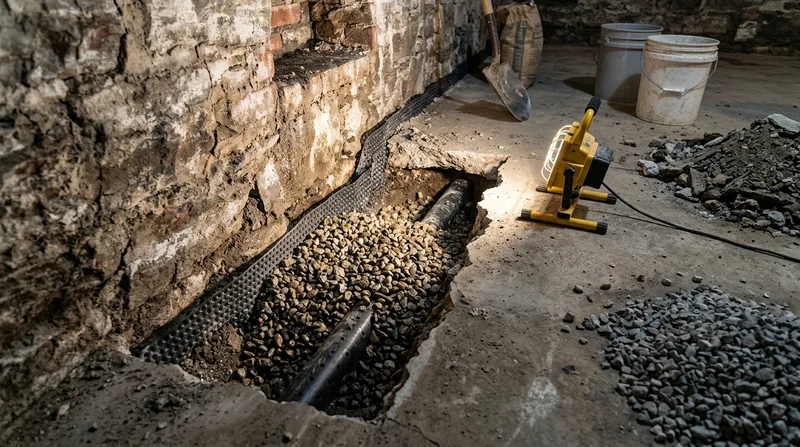




Interior Drain Tile System in Scranton: Stopping Water at the Footing
An Interior Drain Tile System in Scranton is the workhorse fix for wet basements on the Lackawanna Valley's steep, wet lots. Our city sits in a narrow river valley between steep wooded ridges, with glacial till over shale and old anthracite mine workings shifting beneath half the neighborhoods. When spring snowmelt or a summer nor'easter dumps water against a 1900s fieldstone foundation in Green Ridge or a 1960s block basement in South Abington, that water has nowhere to go but in. We cut the slab edge, capture groundwater at the footing, and pump it out before it ever reaches your floor.
This is not a patch job. It is a permanent perimeter solution that works year-round, even in deep winter. If you are dealing with a wet basement, learn how it fits into our full basement waterproofing approach.
Why Interior Drain Tile Matters in Scranton's Old and New Basements
Scranton homes fail differently depending on when they were built. The Hill Section and Green Ridge Victorians sit on fieldstone and brick foundations that have absorbed 120 years of freeze-thaw cycles. West Side double-blocks often have stone footings with no drain tile at all. Meanwhile, 1990s and 2000s poured-concrete basements in the Abingtons and Moscow crack along cold joints when the water table rises after heavy rain.
- Hydrostatic pressure pushes water through fieldstone mortar joints and block cores after every major storm.
- Glacial clay soil traps water against the footing and slows drainage to a crawl.
- Old anthracite mine workings settle unevenly, opening cracks that let groundwater pour in.
- Existing weeping tile from the 1950s is often crushed, clogged, or tied to a dead storm line.
An interior perimeter drain addresses all of these by giving water a controlled path to a sump basin instead of your floor.
Key info: After Tropical Storm Lee in 2011, homes along the Lackawanna River and creek bottoms in South Side and Dickson City took on water through the footing, not the walls. Interior drain tile captures that rising water before it spreads across the slab.
For official guidance on permits and contractor requirements, check the City of Scranton website and confirm current rules with the local building department.
How We Install an Interior Drain Tile System in Scranton
We start by finding where the water is actually entering. That means a full basement inspection, checking wall seepage, efflorescence, and the condition of any existing drain tile. Then we build the system to fit your foundation type, whether it is a rubble stone footing in Old Forge or a poured wall in Clarks Summit.
- We break and remove a 12 to 16 inch strip of concrete slab along the perimeter wall.
- We dig down to the footing and shape the trench so water flows toward the sump point.
- We lay perforated drain tile in washed stone and wrap it in filter fabric to keep glacial clay out.
- We set the sump basin, connect the discharge line, and install a check valve.
- We pour new concrete over the trench and test the system with water before we leave.
Every installation includes a transferable warranty and a clear walkthrough of how the sump pump and discharge line work.
Key info: On a 1920s frame double-block in Taylor, the original footing drain was crushed under a settled addition. We routed the new interior perimeter drain around the addition and tied it into a single sump basin, so both halves of the basement now drain to one pump.
If your existing system is failing, see our drain tile repair page before you assume the whole system needs replacing.
Interior Drain Tile System Methods We Use
The right method depends on your foundation, your water volume, and how much headroom you can spare. We match the approach to the house, not the other way around.
| Approach | Description | Best for |
|---|---|---|
| Full-perimeter interior drain | Continuous trench along all walls, tied to one sump basin. | Wet walls on multiple sides, high water table. |
| Partial perimeter drain | Drain tile along the wet wall or walls only. | Isolated seepage on one side of the basement. |
| Drain tile plus vapor barrier | Perimeter drain paired with wall plastic to control moisture. | Damp, musty basements with efflorescence. |
| Drain tile plus crack injection | Perimeter drain combined with epoxy or polyurethane injection. | Active cracks plus footing water. |
| Drain tile plus battery backup | Sump basin with a battery backup pump on the discharge line. | Homes that lose power during nor'easters. |
We size the system to your square footage and water volume, so you do not pay for drain tile you do not need.
Interior Drain Tile System Cost in Scranton: What to Expect
Most interior drain tile work in Scranton starts around From $50 per linear foot, and the final number depends on your foundation and access. A simple partial run on a block basement in Dickson City sits near the low end. A full perimeter on a fieldstone foundation in the Hill Section, with tight access and thick stone footings, moves toward the high end.
- Linear footage is the biggest driver, since you pay by the foot of trench and tile.
- Foundation type matters: fieldstone and brick footings take more labor than poured concrete.
- Access to the basement, including door width and stairs, affects how fast we can move material.
- Sump basin, pump, and discharge line add to the base price of the drain itself.
- Unexpected conditions, like old mine settling or a crushed footing drain, can add scope.
Get two or three written estimates and compare what is included, not just the bottom line. Our pricing page breaks down the line items so you can compare fairly.
Choosing an Interior Drain Tile System Contractor Near Me in Scranton
Waterproofing is a specialty, and not every foundation contractor or plumber does it well. Ask for proof of licensing and insurance, and get the certificate in writing before work starts. Ask how long the crew has worked on Lackawanna Valley foundations specifically, because fieldstone and mine-settled footings are their own animal.
- Confirm the contractor is licensed and insured, and request a certificate of insurance.
- Get at least two or three estimates in writing with a clear scope of work.
- Ask for local references from Scranton, Dunmore, or Clarks Summit jobs you can call.
- Ask who pulls the permit if the work alters drainage or the sump discharge connection.
- Read the warranty terms and confirm they are transferable.
We are a Basement Health Association member and a dedicated waterproofing specialist, not a general foundation firm. Reach out through our contact page to schedule a free basement inspection.
If you are in the 18510 zip, our Scranton interior drain tile page covers neighborhood-specific conditions.
Interior Drain Tile System in Scranton: Pricing Guide
| Service | Price | Details |
|---|---|---|
| Partial perimeter drain tile | Starting at $50/linear ft | Drain tile along the wet wall only, tied to a sump basin; shorter runs keep the price low. |
| Full-perimeter interior drain | Starting at $50/linear ft | Continuous trench on all walls with sump basin and discharge; total footage drives the price. |
| Drain tile plus sump pump package | Starting at $2,500 | Includes basin, primary pump, check valve, and discharge line; pump capacity moves the number. |
| Fieldstone or brick foundation | On estimate | Thick stone footings and tight access need an on-site look before we quote a number. |
| Travel | Included | In Scranton and surrounding Lackawanna Valley towns, with no separate call-out or mileage fee. |
| Estimate | Free | Response within 24 hours at (272) 770-2393, with no obligation to book. |
Indicative pricing, the exact cost depends on square footage, finish, and site access. Free personalized estimate within 24h at (272) 770-2393.


