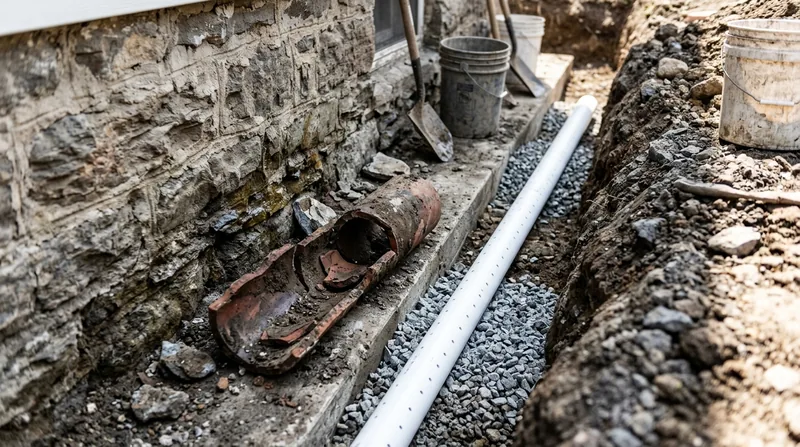




Drain Tile Repair & Replacement in Scranton: When the Original Footing Drain Has Already Failed
If your basement takes on water after every hard spring rain, the problem is often not the wall itself but the drain tile repair and replacement in Scranton that your house has been waiting fifty years for. Scranton sits in the narrow Lackawanna River valley between steep wooded ridges, and the housing stock tells the story: 1870s to 1920s Victorian and Queen Anne homes in the Hill Section and Green Ridge sit on fieldstone and brick foundations, while the frame double-blocks of the West Side and South Side and the coal-patch boroughs of Dunmore, Old Forge, and Taylor still run on original clay tile laid before 1950. That clay tile has cracked, silted in, or been strangled by maple and oak roots from the ridge above. When the footing drain stops moving water, hydrostatic pressure builds in the glacial till and shale and pushes water through the cove joint and every crack it can find. We inspect the drain, find the actual break, and replace it with modern PVC that carries water to the sump basin where it belongs. Start with a free basement inspection so we can tell you whether you need a targeted repair or a full perimeter replacement.
Why Failed Footing Drains Are So Common in Scranton's Older Neighborhoods
Most drain tile failures in this city come down to age and soil, not bad luck. The original weeping tile under a 1910 home in Green Ridge was often unglazed clay laid in a gravel trench, and a century of glacial clay soil migrating into the joints has turned it into a silt-filled pipe that drains nothing. Add the freeze-thaw cycle that hits Lackawanna Valley every winter and spring, the heavy nor'easter snow load, and the spring snowmelt that soaks the till, and the drain is asked to move more water than it was ever built for.
- The drain line is clogged with silt and clay soil, so water backs up against the footing instead of running to the sump basin.
- Tree roots from oaks, maples, and hemlocks have entered through open joints and collapsed the tile.
- The original tile has cracked or separated where old anthracite mine workings beneath the valley caused settlement.
- The drain was never connected to a working sump pump, so it discharges into the same soil it just collected from.
- Downspouts and grading dump roof water right over the footing, overwhelming a drain that is already half blocked.
Any one of these will keep a basement wet no matter how many times you patch the wall, which is why we camera the line before we quote a repair.
Key info: On a 1920s double-block in Dunmore we recently scoped, the clay tile was intact for the first fifteen feet and completely crushed under a mature silver maple at the rear corner. A full perimeter dig would have been wasted money. A targeted repair at the break restored drainage for a fraction of the cost.
If you want to understand how the drain ties into the rest of the system, the interior drain tile system page explains how a modern perimeter drain and sump basin work together. For permit questions on work that alters drainage or the sanitary connection of a sump discharge, verify the current rules with the City of Scranton building department before scheduling, because thresholds vary by jurisdiction.
How We Diagnose and Replace a Failed Drain Tile in Scranton
We do not guess at a drain problem. The sequence below is what a real repair looks like on a Scranton property, from the first camera run to the final discharge test. Every step is aimed at finding the actual failure point so you pay for the repair you need and not a full excavation you do not.
- We walk the basement and the exterior grade, note efflorescence, wall seepage, and where water pools after rain, and check the sump basin and pump.
- We run a camera through the existing drain line to locate clogs, root intrusion, collapsed sections, and the depth of the original footing drain.
- We mark the failure points and give you a written scope: targeted repair, sectional replacement, or full perimeter replacement.
- We excavate only where the line has failed, protect the foundation, and remove the old clay tile and root mass.
- We install new perforated PVC in a washed gravel bed with filter fabric, correct the fall to the sump basin, and tie in the discharge line.
- We backfill, restore grading so water runs away from the wall, and test the whole line with water before we call the job done.
On homes in the Abingtons with poured-concrete basements from the 1990s and later, the failure is usually a crushed section at the footing or a blocked discharge rather than a century of silt, and the repair is correspondingly smaller.
Local example: A split-level in South Abington had water on the basement floor every March for years. The drain tile was clear, but the discharge line ran uphill and froze. We re-graded the line, added a proper check valve at the sump, and the spring snowmelt now leaves the floor dry. Details on the pump side are on our sump pump installation and replacement page.
Drain Tile Repair Approaches We Use in the Lackawanna Valley
Not every wet basement needs the same fix. The table below shows the approaches we actually use on Scranton-area homes, what each one involves, and the situation where it is the right call. We recommend the smallest intervention that solves the problem.
| Approach | Description | Best for |
|---|---|---|
| Camera inspection and spot repair | We scope the line, locate the single break or clog, and excavate only that section. | Older homes where most of the clay tile is still sound. |
| Sectional PVC replacement | We replace a run of failed tile with perforated PVC in washed gravel and filter fabric. | Root intrusion or a collapsed run under one corner of the house. |
| Full perimeter replacement | We replace the entire footing drain and tie it into the sump basin and discharge line. | 1890s to 1950s homes where the clay tile has failed throughout. |
| Interior perimeter drain | We cut a channel at the interior footing and run a new drain to the sump. | When exterior excavation is impractical or hydrostatic pressure is the driver. |
| Discharge and grading correction | We fix the discharge line, check valve, and exterior grading so water leaves the footing. | Drains that are clear but overwhelmed by roof and surface water. |
If the walls themselves are showing bowing or horizontal cracking from pressure, the drain is only part of the answer, and we will tell you so plainly. For those cases see our bowing wall repair page.
Drain Tile Repair & Replacement Cost in Scranton: What to Expect
Most drain tile repair work in Scranton starts at From $750 for a camera inspection and a targeted spot repair, and moves up from there based on how much of the line has failed. A sectional replacement under one corner of a West Side double-block typically runs into the low thousands, while a full perimeter replacement on a large fieldstone foundation in the Hill Section is a bigger project that needs an on-site number. The factors that move the price are the length of failed tile, the depth of the footing, access for excavation, whether roots have to be cut, and whether the discharge line and sump need work at the same time.
Getting two or three written estimates is smart on any drain job because the scope can vary widely between contractors. Ask each one whether they camera the line, what length of tile they are replacing, and whether the price includes grading and discharge correction. Our pricing overview lays out the ranges we work from so you can compare quotes on the same footing.
What to Look For When Hiring a Drain Tile Contractor Near Me in Scranton
Hiring the right contractor matters more on drain work than on almost any other basement job, because the failure is buried and you cannot see whether the repair was done correctly until the next heavy rain. Use the checklist below before you sign anything, and do not be shy about asking for proof.
- Confirm the contractor is licensed and insured and ask for a certificate of insurance before work starts.
- Get at least two or three written estimates that state the length of tile being replaced and whether camera inspection is included.
- Ask for local references from jobs in Scranton, Dunmore, or Clarks Summit and call them.
- Ask who pulls any permit required by the local building department for work that alters drainage or the sump discharge connection.
- Make sure the written scope includes backfill, grading, and a water test of the finished line.
When you are ready to talk it through, reach us through the contact and free estimate page or call (272) 770-2393, and we will set up a time to look at the drain and give you a straight answer.
Drain Tile Repair & Replacement in Scranton: Pricing Guide
| Service | Price | Details |
|---|---|---|
| Camera inspection and spot repair | Starting at $750 | Includes camera scope of the line and excavation at one failure point, with PVC splice and water test. |
| Sectional drain tile replacement | Starting at $1,800 | Replaces a failed run with perforated PVC in gravel and fabric; price moves with length and footing depth. |
| Full perimeter drain tile replacement | On estimate | Requires on-site look at foundation type, access, and whether sump basin and discharge need work. |
| Discharge line and grading correction | Starting at $650 | Fixes frozen or uphill discharge, adds check valve, and re-grades soil away from the footing. |
| Travel | Included | In Scranton and surrounding Lackawanna Valley towns, with no separate call-out or mileage fee. |
| Estimate | Free | Response within 24 hours at (272) 770-2393, with no obligation to book the work. |
Indicative pricing, the exact cost depends on square footage, finish, and site access. Free personalized estimate within 24h at (272) 770-2393.


