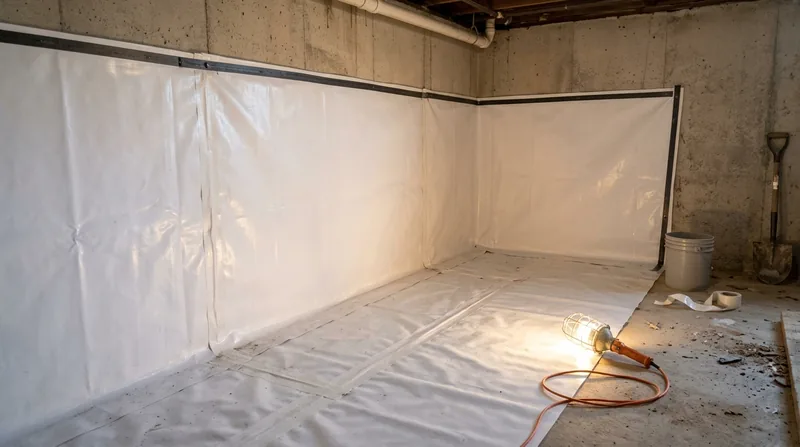




Vapor Barrier Installation in Scranton: Stop Ground Moisture Before It Becomes a Wet Basement
Scranton sits in a narrow valley where glacial till and shale sit under nearly every lot, and that ground holds water long after the rain stops. If your basement smells musty, the walls sweat in July, or white powder blooms on the block, the source is usually moisture vapor moving through the concrete and the slab, not a visible leak. Vapor Barrier Installation in Scranton puts a heavy-duty sheet membrane between your living space and that damp valley soil, with sealed seams and taped terminations so the barrier actually works as a system. We install it on basement walls and across the slab, tie it into the sump basin where the floor drains, and leave you with a drier lower level you can actually use. This is below-grade work on 1870s fieldstone in the Hill Section and poured walls in the Abingtons alike, and the details differ on every one. Start with a free basement inspection so we can tell you whether you need a barrier, a drain, or both.
Why Scranton Basements Stay Damp: Glacial Clay, Mine Workings, and Freeze-Thaw
Lackawanna Valley soil is heavy glacial clay over shale, and it does not drain. Water perches on top of it, pushes against your foundation walls as hydrostatic pressure, and rises through the slab as vapor. Add anthracite mine workings beneath much of the valley that settle and crack foundations, plus river and creek bottoms that took on water in 2006 and again during Tropical Storm Lee in 2011, and you get a building stock that fights moisture from every direction. The vapor barrier is the piece that handles the invisible half of the problem.
- Frame double-blocks on the West Side and South Side sit on stone foundations that wick groundwater straight into the block.
- 1950s to 1970s ranches in Clarks Summit and South Abington have block basements that show efflorescence within a season of a wet spring.
- Newer poured-concrete basements in the Abingtons and Moscow still pass vapor through the slab, which is why the floor feels clammy even with no standing water.
- Hard freeze-thaw cycles and nor'easter snowmelt drive a sharp spring surge that finds every unsealed seam and penetration.
When the vapor load is the main problem, a barrier plus sealed seams solves it. When water is actually standing, the barrier goes in with a drain system, not instead of one.
Key info: A Green Ridge homeowner called us about a musty smell every June. There was no visible leak, but the slab was passing vapor all summer. We installed a sealed wall and slab barrier tied to the existing sump, and the moisture readings dropped within two weeks.
For the code side of any work that alters drainage or the sump discharge connection, check with the City of Scranton licensing and codes office before scheduling, since requirements vary by jurisdiction. You can review the city's permit information at scrantonpa.gov.
How We Install a Vapor Barrier in a Scranton Basement
We start by finding out where the moisture is coming from, because a barrier installed over an active leak just traps water behind plastic. On a Dunmore stone foundation we check the mortar joints and the footing line. On a Clarks Green poured wall we check for shrinkage cracks and slab penetrations. Then we map the layout, order the right sheet width, and schedule the install around your sump and any floor drains.
- We inspect the walls, slab, and sump basin and note every penetration, crack, and cold joint.
- We clean and prep the surfaces so the adhesive and seam tape bond properly, which matters on old parged stone.
- We cut and hang the heavy-duty barrier sheet with a continuous overlap at seams and terminations.
- We seal every seam and tape the top and bottom terminations so vapor cannot escape around the edges.
- We integrate the barrier with the sump basin and discharge path where the floor drains.
- We walk the job with you, show the sealed seams, and explain how to keep the barrier intact.
If the inspection turns up active seepage, we tell you plainly and quote the right fix, which may be an interior drain tile system before any barrier goes down.
Key info: On a 1920s double-block in Taylor, the stone foundation was sound but the slab was the vapor source. We installed a full slab barrier with a sealed perimeter termination and tied it to the sump. No excavation, no drain tile needed, and the basement stopped sweating.
Vapor Barrier Approaches We Use on Scranton and Lackawanna County Basements
Not every basement gets the same sheet and the same detailing. The right approach depends on the wall material, the slab condition, and whether a drain system is already in place. Here is how we match the method to the building.
| Approach | Description | Best for |
|---|---|---|
| Wall barrier with dimple board | Heavy sheet held off the wall with a drainage profile so any seepage drops to the drain. | Stone and block walls in the Hill Section and West Side with minor seepage. |
| Slab vapor barrier | Sheet laid over the floor with sealed seams and a taped perimeter termination. | Damp slabs in 1950s to 1970s ranches in Clarks Summit and South Abington. |
| Full wall and slab system | Continuous barrier from the top of the wall across the floor, tied into the sump basin. | Poured basements in the Abingtons and Moscow with high vapor load. |
| Barrier with drain integration | Barrier installed over a new or existing perimeter drain and sump, sealed at every penetration. | Old Forge and Dickson City basements with both vapor and active water. |
We pick the lightest system that solves the actual problem, and we say so when a simpler approach is enough.
Vapor Barrier Installation Cost in Scranton: What to Expect
Most Scranton vapor barrier work starts from $3 per square foot of treated wall and floor area, and that figure moves with the condition of the surfaces, the number of penetrations, and whether the barrier has to integrate with a sump or drain system. A clean poured wall in South Abington is a faster job than a parged stone foundation in North Scranton where every seam needs custom detailing. We price the sheet, the seam tape, the terminations, and the labor as one number so there are no surprises.
Get two or three estimates and compare what is actually included, not just the total. Ask whether seams and terminations are sealed, whether the sump is integrated, and whether the quote covers surface prep. A low number that skips the taping is not a bargain. You can see how we structure jobs on our pricing overview.
Vapor Barrier Installation Near Me: How to Vet a Scranton Waterproofing Contractor
Plenty of outfits will hang plastic in a basement and call it waterproofing. The difference is in the prep, the seam sealing, and whether the contractor understands what is happening under your specific foundation. Use these checks before you sign anything.
- Confirm the contractor is licensed and insured for basement work in Pennsylvania and ask for a certificate of insurance.
- Get at least three written estimates with itemized scope, and make sure each one states how seams and terminations are sealed.
- Ask for local references from jobs in Scranton, Dunmore, or Old Forge and call them.
- Ask who pulls any required permit if the work touches drainage or the sump discharge connection, and verify the rule with the local building department.
- Check that the company carries a transferable warranty in writing and will put it in the contract.
We are a Basement Health Association member and we will tell you when a barrier is not the right answer. Reach out through our contact page to set up a free inspection at (272) 770-2393.
Vapor Barrier Installation in Scranton: Pricing Guide
| Service | Price | Details |
|---|---|---|
| Slab vapor barrier only | Starting at $3/sq ft | Includes surface prep, sheet layout, sealed seams, and taped perimeter termination. |
| Wall barrier with dimple board | Starting at $4/sq ft | Includes wall prep, drainage profile, sealed seams, and top termination detailing. |
| Full wall and slab system | Starting at $5/sq ft | Continuous barrier tied into the sump basin, priced by total treated square footage. |
| Barrier with drain integration | On estimate | Needs an on-site look to price drain tie-in, sump connection, and penetration sealing. |
| Travel | Included | In Scranton and surrounding areas, no separate call-out or mileage fee. |
| Estimate | Free | Response within 24h at (272) 770-2393, no obligation to book. |
Indicative pricing, the exact cost depends on square footage, finish, and site access. Free personalized estimate within 24h at (272) 770-2393.


